

.svg)
.svg)
.svg)

.svg)














.svg)
.svg)


Hack your behavior - A fresh start to 2021
Have you struggled with your daily habits during the COVID-19 quarantine? Do you spend too much time on social media while stay at home orders are in place? Perhaps you can’t get yourself to workout? Or you feel less productive? These are the most common daily routine issues many complained about during 2020.
These ultimately come down to issues with self-regulation or self-discipline and they are often present even when we don’t have to stay at home all the time.
The thing is, it’s not that we don’t want to eat healthy or that we enjoy being lazy. We want to make the right choices - it’s just that when it comes to realization- we fall short. It is no secret that humans don’t always make the most rational decisions and rarely choose what is in our best interest.
So, how do we change our behavior when our own minds and willpower play tricks on us?
Behavioral economics maybe has a way around it - the magic word is nudging. “What is a nudge?”, you might wonder. Nudges are what we call “behavioral interventions'', or - things we learned from psychological research that is proven to steer people’s behavior toward making better choices (like eating healthy or staying hydrated) - often without their knowledge or intentions. These strategies are used as a means to influence decision-makers when it comes to consumption, energy use, climate change, education, organ donations, and many more. The core idea we need to understand about nudging is that one’s behavior is at large influenced by one’s environment and that changing our behavior requires adjusting our environment so that better choices become easier to make. This is what we call choice architecture.
And this is not a new idea: perhaps making smaller cash withdrawals at an ATM is a strategy you used to avoid spending more money.
Now how about using actual psychological principles to trick your mind and structure your behavior in a way that benefits your life?
Reduce the hassle!
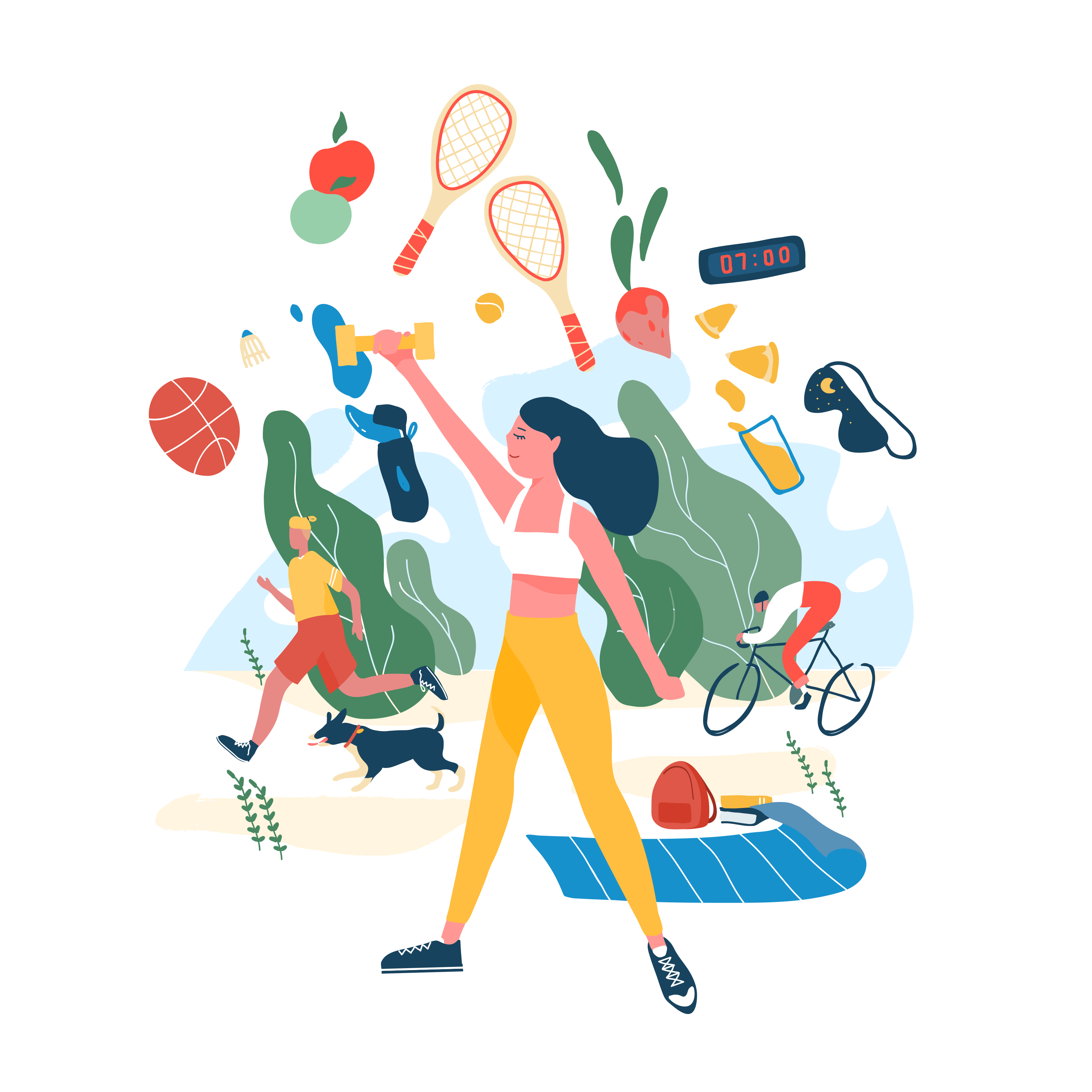
Since most people tend to preserve energy and avoid what requires more effort, it has been proven that reducing “hassle”, or making the better choice easier or more accessible works to our advantage. For example, we want to workout at home during the lockdown, but it’s just too much of a hassle to actually do it. Here’s a tip: Reduce the hassle! Prepare your workout gear beside your bed so that you are directed towards it the first thing in the morning, pick a YouTube workout video before going to sleep the night before. With every little habit, you struggle with - make the best choice easily available, prepare your environment, and prime yourself for success.
Reduce the accessibility of temptation
In the same way, a slight inconvenience can turn us away from working out, it can also avert us from a desired, but an unhealthy object. For example, by not keeping sweets or sugary drinks in our home, we make it less accessible and by increasing the hassle needed to get it - it is less likely that we’ll actually do it. Although this might seem obvious, we underestimate the power of “hiding our temptations” from ourselves. If you want to reduce the time you spend on your phone, make it a hassle to do it - while you’re studying in your room, leave it on the charger in another room. This not only makes a phone less accessible, but it creates a time gap between an urge to check your phone and the moment you can actually reach it, and so gives you the time to reflect and remember to control yourself and get your focus back on the task.
Make it a part of your identity
We behave in a way that fits the way we see ourselves. When we engage in behaviors that are not aligned with our perceived identity, this creates a certain cognitive dissonance and a feeling of unease. Therefore, it would be beneficial to frame desirable behaviors as a part of our identity. For example, to stop eating unhealthy, we can start by questioning our values and seeing that health and fitness are important to us and that we believe fiercely that eating healthy is in accordance with our perceived identity and thus a logical continuity of our other habits. After making this thought a part of our belief system, it would be very uncomfortable for us to eat unhealthy because we have a natural motivation to maintain consistency between our identity (attitudes, values..), and our actions.
Social norms
As humans, we want to fit in and to be accepted within our social group, so we often choose to do whatever others do, because other peoples’ behavior serves as a reference point for our own. That’s why social norms can sway our behavior. This is why it is useful to find a workout or a studying buddy, who will keep you accountable for your progress and give you an impression that working out or studying is something that everybody does and you should too. If possible, try to be mindful of your social media networks’ feed - what you choose to follow online, in a way becomes your version of reality and your reference for what is right and desirable and you strive for it, so make sure you feed your brain the right content.
Reminders and prompts
We often go through our days on autopilot, not really being conscious of every little decision we make. Reminders can help us steer our day-to-day life in the direction that suits us. A lot of apps for making habits are based on this principle. You can use an app or make your own reminders for meditation or for tracking your daily water intake. A good example would also set up a reminder when you reach a certain amount of screen time, to reduce your phone usage. If you want to reduce the usage of plastic bags, set up a reminder to get your reusable bag on a spot you pass right before going grocery shopping.
Implementation intention - IF-THEN action plans
As we said, it can be difficult to follow through with the decisions we make, even if they are in our best interest. Research in psychology has shown that making specific and detailed action plans can help us stay on track and avoid different pitfalls and fallacies in following through with the desired behavior. IF-THEN action plans require us to think of all the reasons we might fail to go through with our plan and figure out the specific actionable solutions, we will take in those cases. It’s important to define when, where, and how you will manage your temptations. For example, if the desired outcome is to stay focused while studying, an IF-THEN action plan might look something like this:
- If I have the urge to check my phone while studying, I will commit to delay my urge for just 10 more minutes and continue reading.
- If I have the urge to check something random on the internet while studying, I will write it down on a piece of paper and check it after my study session.
- If a friend invites me to go out before an important exam, I will decisively decline the invitation and remind myself how good it will feel when I get a good grade on that exam.
To sum up, many other psychological tricks can help us structure our environment to keep ourselves in check. The most important takeaway is to raise self-awareness of our behavior and our surroundings to see the gaps between our goals and our behavioral patterns. Then, we can master our daily habits during quarantine or in the post-pandemic world, by using science to help us come closer to our goals.
Further reading:
Reijula, S. & Hertwig, R. (2020). Self-nudging and the citizen choice architect. Behavioral Public Policy, 1-31. doi:10.1017/bpp.2020.5